

An online register of student work and experiences.
Showing posts with label Grupo 4 - Fabíola. Show all posts
Showing posts with label Grupo 4 - Fabíola. Show all posts
Saturday, 9 November 2013
At The Car Wash
Here is a wonderful activity that you can do at home with your child. It's a lot of fun and creates opportunities to practice naming colours in English. Take some toy cars and paint them different colours, wash them off and start again! You'll be surprised how many times they'll want to do this before the novelty wears off. We have great big sensory tub at school but at home you should probably get your child to do this in the shower cubicle. ;-)

Free Play in Shoe Box City
We took the shoe box houses that we made during the week and turned them into a mini-city that the kids played in today during English class. It was a great way to finish off our unit of work on My House.

Tuesday, 5 November 2013
My House - My Home
We are learning the rooms of the house this week: bedroom, bathroom, living room and kitchen.
Here are some pics of our students doing worksheets. One was a listen and paint activity and the other was a free activity where the students could decorate a picture of the house in any way they wanted.

We read the story of the Three Little Pigs and as a follow up activity made 3D houses using straws, sticks and bricks.

Then along came the Big Bad Wolf to blow the houses down! There were two things that I really loved about this activity. The first was hearing the children using English spontaneously as they played, calling out to the wolf and then chanting the lines from the story. The second was seeing how hard they worked at building strong houses which would withstand the wolf.

Here are some pics of our students doing worksheets. One was a listen and paint activity and the other was a free activity where the students could decorate a picture of the house in any way they wanted.

We read the story of the Three Little Pigs and as a follow up activity made 3D houses using straws, sticks and bricks.

Then along came the Big Bad Wolf to blow the houses down! There were two things that I really loved about this activity. The first was hearing the children using English spontaneously as they played, calling out to the wolf and then chanting the lines from the story. The second was seeing how hard they worked at building strong houses which would withstand the wolf.
Tuesday, 22 October 2013
Australia Project: Australian Aboriginal music
This song was such a big hit that I've been hearing it sung around the school all week. Taba Naba is a traditional children's song from the Torres Strait Islands of the North coast of Australia.
Here are the words and translation:
Taba naba naba norem
Tugi penai siri
Dinghy e naba we
Miko keimi
Sere re naba we
Taba naba norem (style)
(repeated 3 times)
Translation:
Come on let's go to the Reef
Get into the dinghy when the morning tide is low
Let us row to the edge of the reef
Come on let's go to the reef.
Most of you have probably seen the video performed by XuXa. While she got the words right, unfortunately the costumes and music are from Hawaii NOT the Torres Strait. Here is an Australian version:
Here are the words and translation:
Taba naba naba norem
Tugi penai siri
Dinghy e naba we
Miko keimi
Sere re naba we
Taba naba norem (style)
(repeated 3 times)
Translation:
Come on let's go to the Reef
Get into the dinghy when the morning tide is low
Let us row to the edge of the reef
Come on let's go to the reef.
Most of you have probably seen the video performed by XuXa. While she got the words right, unfortunately the costumes and music are from Hawaii NOT the Torres Strait. Here is an Australian version:
Australia Project - Story: Ernie Dances To The Didgeridoo
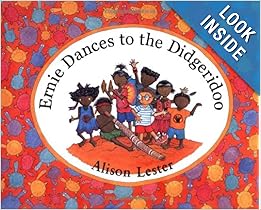
- Playing Tin-Tin.
- Making a traditional Australian bread called Damper
- Face painting
- Learning the words and actions to a traditional Australian song: Taba Naba
- Dot painting
- Listening to Didgeridoo music


Here's a link to the recipe! DAMPER

Learn more about this ancient art form here.
Australia Project - Story: Wombat Stew
Gooey, brewy, yummy, chewy...Wombat Stew! This chant is from the book we read this week called Wombat Stew by Marcia Vaughan. This hilarious story tells the tale of a group of Australian animals who try to save their friend Wombat from ending up in Dingo's stew.
 To follow up our story, we played with some Australian animal puppets and pretended to make Wombat Stew in the sensory tub.


Saturday, 19 October 2013
I Like Bananas
This song originally came from the Robby Rabbit EFL textbook by Carol Read. I use the words and melody to play a game which is similar to Duck, Duck, Goose. Everyone loves this game and the song is extremely catchy. Here is how we play…
The children sit on the floor in a
circle. One child is chosen to go around
the outside of the circle tapping each child’s head in turn while the group
sing…
I like bananas,
I like apples,
I like sandwiches,
I like biscuits, too.
At the end of the song, the standing child must ask the child
sitting before him/her a question “Do you like (apples)?”. The sitting child must answer the question
before jumping up to chase the other. The objective is to get around the circle
and sitting down without being caught.
Friday, 11 October 2013
Sometimes and everyday food

apple banana biscuit sandwich chicken meat cake
lollipop pasta tomato pizza juice water milk chocolate
lollipop pasta tomato pizza juice water milk chocolate


Friday, 4 October 2013
The Very Hungry Caterpillar
This classic children’s book by Eric Carle
tells the story of the lifecycle of a butterfly. It also introduces the days of the week and
the concept of healthy eating habits. It
was the perfect story for our unit of work on Sometimes and Everyday Food.

Friday, 27 September 2013
Group 4's Science Project
In this project, the children in Group 4 focused on Biological
Science - the study of living things. We asked the key question: “What
is alive?” As part of this project the children explored the following
concepts:


These concepts were discovered through participation in the following activities:


- Living things have basic needs
- Plants grow from seeds
- Plants need sun and water
- Living things have life-cycles


These concepts were discovered through participation in the following activities:
- Use of stories, reference materials and live observation to discover the lifecycle of different animals and insects
- Examining the growth of seeds under different conditions
- An outdoor work station set up with activities which encourage the exploration and discovery of plants, flowers and seeds
- Observing the effects of bacteria on a slice of apple
- Use different mediums (including recordings, photographing and creating artwork) which document these experiences and discoverie


Monday, 23 September 2013
Preschool Science Fair

This Friday is the Feira Integrada at Upuêre and in English class the children have been conducting experiments which will be on display at our very own Science Fair!


Thursday, 19 September 2013
Tuesday, 17 September 2013
I Can Sing A Rainbow
This is the song we are singing this week. The children have picked it up really quickly and sing it so beautifully. I'll get a video up here soon!
Looking After Our Pets
More kids have sent in their beautiful photos and here they are! Great to see so many of you looking after your pets. Good Job!!


Saturday, 14 September 2013
How Many Bugs In The Box?
This was our story during our Seeds, Flowers and Leaves theme. It seemed like a good fit considering we had also been looking at some of the insects that live in our playground and playing with toy-bug sensory trays.

We practised "How many....?" and numbers 1 - 10.


We practised "How many....?" and numbers 1 - 10.


Nature Scavenger Hunt


I did this activity after a guessing game which was played at circle time. The children had to guess how many bugs I had put in a bottle. After passing the bugs around the circle, we read the story of the week "How Many Bugs In The Box".
Julia teaches her pet to use the I-pad

Julia, from Group 4, has a very modern pet! It loves using new technology, especially the iPad. I wonder if it has an account on Fcaebook and twitter?
What are you doing this weekend with you pet?
Saturday, 7 September 2013
Sorting Seeds
Here are some more photos from our lesson outside on seeds, leaves, flowers and fruit. The kids in Group 4 had a great time at our Discovery Table. One of the best things about the lesson was getting to use our new magnifying glasses. Another popular activity was the seed sorting tray, which involved using tweezers to sort different types of seeds.


Friday, 6 September 2013
What do seeds need?
Young children are naturally curious and constantly exploring the world around them. Classroom science provides the opportunity for children to extend this natural curiosity and building of theories. The children in Group 4 did an experiment to test the conditions which a seed needs to germinate.
The target language was sun, water and seed. We asked the key questions "What does a seed need to grow?" and "What will happen to these seeds?". We learned about making a hypothesis, observed the seeds during the week and then discussed the results.

Subscribe to:
Posts (Atom)