

An online register of student work and experiences.
Showing posts with label Group 5 - Isadora. Show all posts
Showing posts with label Group 5 - Isadora. Show all posts
Saturday, 9 November 2013
Free Play in Shoe Box City
We took the shoe box houses that we made during the week and turned them into a mini-city that the kids played in today during English class. It was a great way to finish off our unit of work on My House.

Tuesday, 5 November 2013
The Three Little Pigs

The groups have been enjoying hearing the classic story The Three Little Pigs as part of our theme My House. As a follow-up activity, I set the sensory tub up for the children to act out the story using some different props. It was interesting to hear the language they have picked up from they story appearing while they played.

My House - My Home
We are learning the rooms of the house this week: bedroom, bathroom, living room and kitchen.
Here are some pics of our students doing worksheets. One was a listen and paint activity and the other was a free activity where the students could decorate a picture of the house in any way they wanted.

We read the story of the Three Little Pigs and as a follow up activity made 3D houses using straws, sticks and bricks.

Then along came the Big Bad Wolf to blow the houses down! There were two things that I really loved about this activity. The first was hearing the children using English spontaneously as they played, calling out to the wolf and then chanting the lines from the story. The second was seeing how hard they worked at building strong houses which would withstand the wolf.

Here are some pics of our students doing worksheets. One was a listen and paint activity and the other was a free activity where the students could decorate a picture of the house in any way they wanted.

We read the story of the Three Little Pigs and as a follow up activity made 3D houses using straws, sticks and bricks.

Then along came the Big Bad Wolf to blow the houses down! There were two things that I really loved about this activity. The first was hearing the children using English spontaneously as they played, calling out to the wolf and then chanting the lines from the story. The second was seeing how hard they worked at building strong houses which would withstand the wolf.
Tuesday, 22 October 2013
Australia Project: Australian Aboriginal music
This song was such a big hit that I've been hearing it sung around the school all week. Taba Naba is a traditional children's song from the Torres Strait Islands of the North coast of Australia.
Here are the words and translation:
Taba naba naba norem
Tugi penai siri
Dinghy e naba we
Miko keimi
Sere re naba we
Taba naba norem (style)
(repeated 3 times)
Translation:
Come on let's go to the Reef
Get into the dinghy when the morning tide is low
Let us row to the edge of the reef
Come on let's go to the reef.
Most of you have probably seen the video performed by XuXa. While she got the words right, unfortunately the costumes and music are from Hawaii NOT the Torres Strait. Here is an Australian version:
Here are the words and translation:
Taba naba naba norem
Tugi penai siri
Dinghy e naba we
Miko keimi
Sere re naba we
Taba naba norem (style)
(repeated 3 times)
Translation:
Come on let's go to the Reef
Get into the dinghy when the morning tide is low
Let us row to the edge of the reef
Come on let's go to the reef.
Most of you have probably seen the video performed by XuXa. While she got the words right, unfortunately the costumes and music are from Hawaii NOT the Torres Strait. Here is an Australian version:
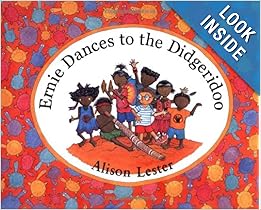
Australia Project - Story: Ernie Dances To The Didgeridoo
- Playing Tin-Tin.
- Making a traditional Australian bread called Damper
- Face painting
- Learning the words and actions to a traditional Australian song: Taba Naba
- Dot painting
- Listening to Didgeridoo music


Here's a link to the recipe! DAMPER

Learn more about this ancient art form here.
Australia Project - Story: Wombat Stew
Gooey, brewy, yummy, chewy...Wombat Stew! This chant is from the book we read this week called Wombat Stew by Marcia Vaughan. This hilarious story tells the tale of a group of Australian animals who try to save their friend Wombat from ending up in Dingo's stew.
 To follow up our story, we played with some Australian animal puppets and pretended to make Wombat Stew in the sensory tub.


Saturday, 19 October 2013
I Like Bananas
This song originally came from the Robby Rabbit EFL textbook by Carol Read. I use the words and melody to play a game which is similar to Duck, Duck, Goose. Everyone loves this game and the song is extremely catchy. Here is how we play…
The children sit on the floor in a
circle. One child is chosen to go around
the outside of the circle tapping each child’s head in turn while the group
sing…
I like bananas,
I like apples,
I like sandwiches,
I like biscuits, too.
At the end of the song, the standing child must ask the child
sitting before him/her a question “Do you like (apples)?”. The sitting child must answer the question
before jumping up to chase the other. The objective is to get around the circle
and sitting down without being caught.
Friday, 11 October 2013
Sometimes and everyday food

apple banana biscuit sandwich chicken meat cake
lollipop pasta tomato pizza juice water milk chocolate
lollipop pasta tomato pizza juice water milk chocolate


Friday, 4 October 2013
The Very Hungry Caterpillar
This classic children’s book by Eric Carle
tells the story of the lifecycle of a butterfly. It also introduces the days of the week and
the concept of healthy eating habits. It
was the perfect story for our unit of work on Sometimes and Everyday Food.

Friday, 27 September 2013
Group 5's Science Project
 The children in Group 5 looked at Earth and Environmental Science - the study of the Earth and its materials and how we care for the natural world. We explored the key question: “How can we care for our world?”
 In this project, we developed the following concepts:
- The weather can change every day
- The sun is powerful
- The sun can affect living and non-living things
- Sunscreen gives protection from the effects of the sun
- Observing, measuring and recording the weather and temperature in a collective weather diary
- Discovering the effects of the sun with an experiment using black paper and sunscreen
- Using different mediums (including recordings, photographing and creating artwork) which documents these experiences and discoverie
Thursday, 19 September 2013
UPUÊRE in Full Colour
We explored colour in all kinds of ways this week. By now, everyone should be able to name red, orange, yellow, green, blue, purple, pink, black, white and brown. Some may even be able to tell you what happens when we mix different primary colours - red and blue makes purple, etc.
We sang the song I Can Sing A Rainbow and read the story Mouse Paint. Here are some of the other activities we did this week...
On Monday, we played a fast-paced game called High-Five. When I called out a colour, the children had to run and touch the hand of the same colour.

On Tuesday, we did the Travelling Colours Experiment. The children love Science Day and become very focused during the activities. You might like to try this one at home. You just need three jars, water and food colouring. Fill two jars with water and colour them in two primary colours. Ask your child to name the colours in English and then try to guess what will happen when they mix. Place a piece of rolled-up toilet paper or kitchen towel between the coloured water and the empty jars (see photos below). Watch as the water is soaked up the paper and travels to the empty jar. When the water starts to mix a new colour will form. If you leave it overnight, you will see that the water levels in the three jars have evened out. Amazing!


On Wednesday, there were lots of centers to explore in the Art Room.
We used eye-droppers, spray bottles, coloured water, paint, bicarb of soda and vinegar in different ways to discover how primary colours can be mixed to make secondary ones.


 On Thursday, we did digital painting with an app called Paint Sparkles. If you put it in English, a voice will name the colour you choose. We also used our paintings from yesterday to make colourful mice for our classroom wall. Come by and see the finished result. It looks wonderful.
The mice were inspired by the book we read this week - Mouse Paint.


We sang the song I Can Sing A Rainbow and read the story Mouse Paint. Here are some of the other activities we did this week...
On Monday, we played a fast-paced game called High-Five. When I called out a colour, the children had to run and touch the hand of the same colour.
On Tuesday, we did the Travelling Colours Experiment. The children love Science Day and become very focused during the activities. You might like to try this one at home. You just need three jars, water and food colouring. Fill two jars with water and colour them in two primary colours. Ask your child to name the colours in English and then try to guess what will happen when they mix. Place a piece of rolled-up toilet paper or kitchen towel between the coloured water and the empty jars (see photos below). Watch as the water is soaked up the paper and travels to the empty jar. When the water starts to mix a new colour will form. If you leave it overnight, you will see that the water levels in the three jars have evened out. Amazing!
On Wednesday, there were lots of centers to explore in the Art Room.
We used eye-droppers, spray bottles, coloured water, paint, bicarb of soda and vinegar in different ways to discover how primary colours can be mixed to make secondary ones.
The mice were inspired by the book we read this week - Mouse Paint.
Friday will be a day in the playground, as usual. I will do a separate post with photos from the fun activities I have planned for the kids to do so check back in tomorrow!
Subscribe to:
Posts (Atom)